Why this one
A European drive turns on the things nobody tells you: that you needed a sticker before joining the Austrian motorway, that Stuttgart requires a windscreen badge, that in Germany your sat-nav is no longer allowed to warn you about a speed check, and that a motorway empties an electric car’s battery a third faster than a town does.
WayCar is written for those moments. It is also why it refuses to display certain things: a speed limit it cannot verify, the number of free bays in a car park, the opening hours of a charger. Apple does not publish any of that, and inventing it is paid for at the barrier, at the car park or in front of a charger that turns out to be shut.
What is on board
- Four costed routesFastest, shortest, cheapest, calmest. The gap between them is shown in minutes and in euros, before you set off.
- Tolls and vignettes per countryThe cost is worked out country by country over the legs the route really crosses: a barrier in France, a sticker in Austria, nothing at all in Germany.
- Low-emission zonesCrit’Air, Umweltplakette, ZTL. The city is named and the scheme is named in its own language.
- Speed checks, under each country’s lawAn aggregated danger zone in France, nothing whatsoever in Germany and Switzerland, the reported position elsewhere. The app says so as you cross.
- Winter equipmentLoi Montagne II, Winterreifenpflicht, zimska oprema. Each country’s published rule with its dates, stated as a rule and not as a verdict about your particular road.
- Electric chargingA plan that never drops below 10 % of the battery, never goes more than 2.5 km off the road, and charges to 80 % rather than 100.
- A break after two hoursThe advice every European road-safety agency gives, said while you are driving, with the services still ahead of you.
- Where you parkedThe level, the bay, your own note, and the walk back to it.
- Ferries spottedA crossing inside the route is flagged on the route card: it has to be booked, and it costs.
- Reports over two pathsDevice to device over a few tens of metres — the car behind you in a tunnel — and over the network for the jam forty kilometres ahead.
- Six voices, three tonesSober, friendly or cheeky. The tone changes the words, never the information: the exit, the street and the delay are always spoken.
- CarPlayReport, search, pick up your saved destinations. The phone and the car drive the same trip.
On screen
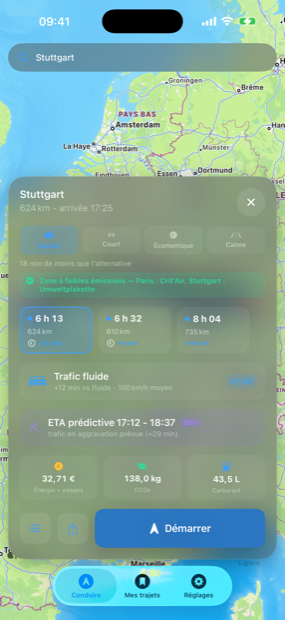
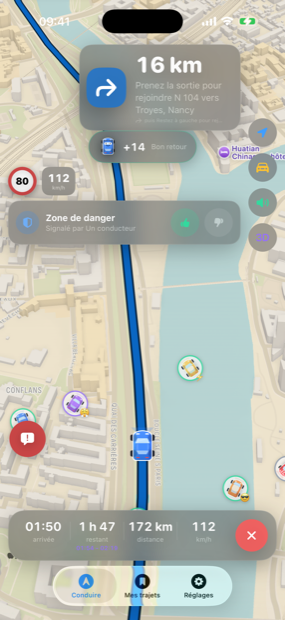
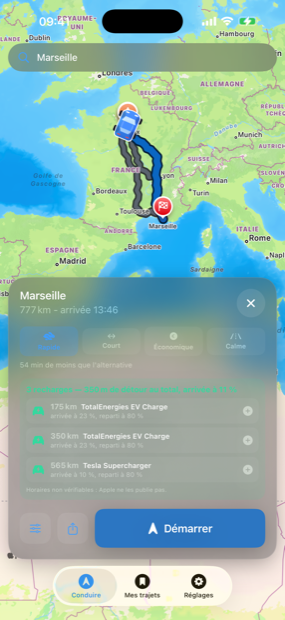
Real captures of the application on iPhone.
What it will not do
WayCar needs a network to compute a route, search for an address and know the traffic. Once the route is computed, guidance carries on without one: the line and the manoeuvres are already in memory. It is not an offline app and it does not pretend to be.
It does not show the speed limit of the road you are on — Apple does not publish it. It shows the statutory maxima of the country, and only warns you when you are certainly above the highest of them.
It does not know whether a charger is open, whether a car park has a space, or what either costs. It gives you the phone number and the web page so you can check.
Toll rates, vignette prices and winter rules are published figures: they change. The signage at the roadside is what counts, always.
Your data
No account, no sign-up, no advertising, no analytics SDK. Your trips, your saved places and your recent destinations stay on the iPhone. What goes out to other drivers is your reports: something that happened to a road, never your live position. The app can export everything it keeps as a readable file, and delete all of it. See the privacy policy.
Availability
iPhone, with CarPlay. French, English, German, Spanish and Italian — interface, spoken guidance and recorded voices. Version 1.1; what changed is in the changelog.